
Blog
Third Party Cosmetic Manufacturers in India | Private Label & Contract Manufacturing

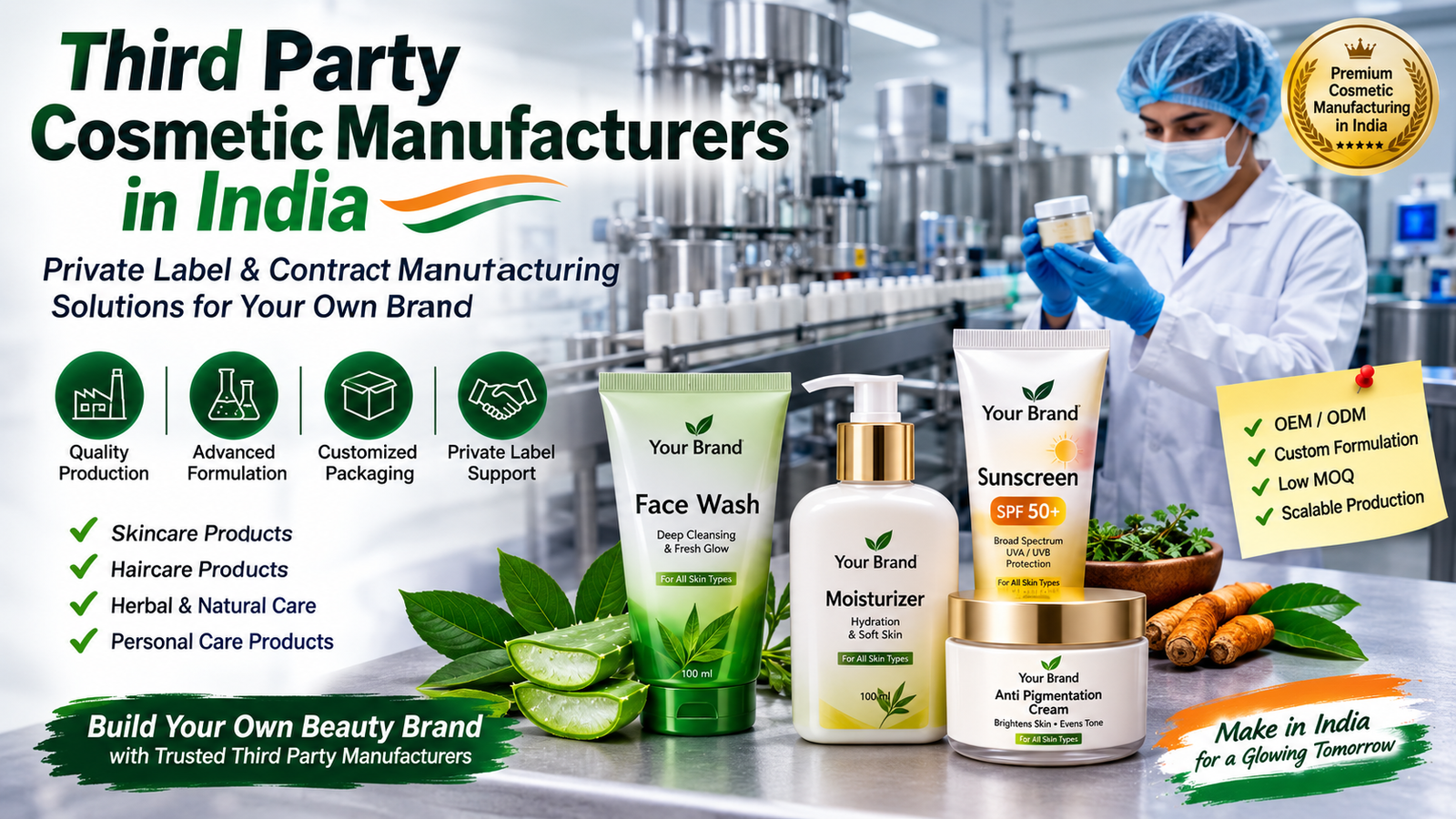
Third Party Cosmetic Manufacturers in India: A Complete Guide for Starting Your Own Beauty Brand
India’s cosmetics and personal care industry has become an attractive opportunity for entrepreneurs, startups, salons, e-commerce sellers, distributors and established brands. However, setting up your own cosmetic manufacturing facility requires significant investment in infrastructure, machinery, manpower, quality control and regulatory compliance. This is where third party cosmetic manufacturing in India becomes an effective business model. Third Party Cosmetic Manufacturers in India
Third party manufacturing allows a brand owner to develop and sell products under its own brand name while an experienced cosmetic manufacturer handles formulation, manufacturing, filling, packaging and other production-related activities. Many Indian manufacturers now offer complete private label and contract manufacturing solutions for skincare, haircare, body care, herbal products and personal care. Third Party Cosmetic Manufacturers in India
What Is Third Party Cosmetic Manufacturing?
Third party cosmetic manufacturing is a business arrangement in which a manufacturer produces cosmetic products for another company or brand. The brand owner generally decides the product concept, packaging, branding and market positioning, while the manufacturing partner takes care of production. Third Party Cosmetic Manufacturers in India
For example, if an entrepreneur wants to launch a skincare brand with products such as face wash, serum, moisturizer, sunscreen and anti-pigmentation cream, they do not necessarily need to build a factory. They can approach a third party cosmetic manufacturer, select or develop suitable formulations, finalize packaging and manufacture the products under their own brand. Third Party Cosmetic Manufacturers in India
This model is also commonly associated with private label, contract manufacturing and OEM cosmetic manufacturing.
Why Choose Third Party Cosmetic Manufacturing in India?
One of the biggest advantages is reduced investment. Building a cosmetic manufacturing facility requires production equipment, laboratories, storage areas, qualified personnel, quality-control systems and regulatory approvals. A third party manufacturer already has much of this infrastructure in place. Third Party Cosmetic Manufacturers in India
Another important advantage is speed. Instead of spending months or years establishing a factory, a new brand can concentrate on product selection, branding, marketing and sales. Third Party Cosmetic Manufacturers in India
Third party manufacturing can also provide access to technical expertise. Experienced manufacturers may have formulation teams capable of developing different textures, fragrances, shades and product formats according to a brand’s requirements. Third Party Cosmetic Manufacturers in India
The model can be particularly useful for:
- New cosmetic startups
- D2C beauty brands
- E-commerce sellers
- Salon and spa brands
- Distributors and wholesalers
- Influencer-led brands
- Herbal and natural product companies
- Existing brands expanding their product range
- Export-oriented cosmetic businesses
Products Manufactured by Third Party Cosmetic Companies
Indian manufacturers offer a wide range of cosmetic and personal-care products. Depending on the facility and its capabilities, a manufacturer may produce products across several categories. Third Party Cosmetic Manufacturers in India
Skincare Products
Common skincare products include:
- Face wash
- Cleansers
- Face creams
- Moisturizers
- Sunscreens
- Face serums
- Anti-aging creams
- Anti-pigmentation products
- Brightening creams
- Face masks
- Scrubs
- Toners
- Under-eye products
Haircare Products
The haircare category may include:
- Shampoo
- Conditioner
- Hair serum
- Hair oil
- Hair masks
- Scalp-care products
- Hair styling products
Body Care Products
Manufacturers may also produce:
- Body lotion
- Body wash
- Hand wash
- Hand cream
- Body scrub
- Bath products
- Foot-care products
Herbal and Personal Care
There is also strong demand for herbal, natural and plant-based cosmetic products. Depending on the formulation and applicable regulations, manufacturers may provide herbal face washes, creams, hair oils, shampoos and other personal-care products. Third Party Cosmetic Manufacturers in India
Private Label vs Custom Formulation
Before selecting a manufacturer, a business should understand the difference between private label and custom formulation.
In a private label model, the manufacturer already has a developed product or formulation. The brand can select the product and customize elements such as label, packaging, fragrance or other permitted specifications.
In custom manufacturing, the brand provides its desired product concept and the manufacturer develops or modifies the formulation according to the required specifications.
Private label products can generally be faster to launch, while custom formulation can provide greater differentiation for a brand.
How to Choose the Best Third Party Cosmetic Manufacturer in India
Choosing the right manufacturing partner is one of the most important decisions for a cosmetic brand. A low quotation alone should not be the deciding factor.
First, check whether the manufacturer has the appropriate manufacturing licence and operates according to applicable cosmetic regulations. Under India’s Cosmetics Rules, 2020, manufacturing licences for cosmetics are handled by the respective State Licensing Authorities.
You should also evaluate the manufacturer’s manufacturing infrastructure, quality-control facilities, product-development capabilities and experience with similar products.
Ask for product samples before placing a large production order. Samples allow you to evaluate texture, fragrance, appearance, packaging compatibility and overall product quality.
It is also useful to understand the manufacturer’s minimum order quantity, production lead time, packaging options, testing procedures and documentation.
Regulatory Compliance Is Important
Cosmetic manufacturing in India is regulated under the Drugs and Cosmetics Act, 1940 and the Cosmetics Rules, 2020. The Central Drugs Standard Control Organization (CDSCO) explains that manufacturing of cosmetics is regulated through inspection and licensing by State Licensing Authorities.
Manufacturers and brand owners should ensure that products meet applicable quality and safety requirements. The Cosmetics Rules also prohibit cosmetic claims that are false or misleading.
For new cosmetics, prior permission from the Central Licensing Authority may be required under the applicable rules. CDSCO’s FAQ states that applications for manufacturing licences and loan licences are made through the prescribed forms under the Cosmetics Rules, 2020.
Therefore, a serious brand should work with a manufacturer that understands regulatory requirements rather than choosing a supplier only on the basis of price.
Packaging and Branding Support
A professional third party cosmetic manufacturer can provide more than manufacturing. Many companies offer complete solutions covering formulation, packaging, filling, labelling and product development.
Packaging plays an important role in the cosmetics industry because customers often make their first impression from the product’s bottle, tube, jar, outer box and label design.
A brand should discuss packaging requirements with the manufacturer at the beginning of the project. Important factors include bottle or tube material, container size, closure type, pump or dropper, label dimensions, printing requirements and compatibility with the formulation.
Quality Control and Testing
Quality should be a priority when selecting a third party cosmetic manufacturer. A reliable manufacturer should have appropriate quality-control procedures and documentation.
Depending on the product, quality checks can include appearance, colour, odour, pH, viscosity, microbial parameters, stability and other relevant specifications.
The manufacturer should also maintain proper batch records and production documentation. Consistency is particularly important because customers expect every batch of a product to have similar characteristics.
What Should You Ask a Manufacturer Before Ordering?
Before finalizing a third party cosmetic manufacturer, ask important questions such as:
- Do you have a valid cosmetic manufacturing licence?
- What product categories do you manufacture?
- Do you provide custom formulation?
- What is your minimum order quantity?
- Can you provide samples before bulk production?
- What packaging options are available?
- What is the expected production timeline?
- What quality tests are performed?
- What documentation is provided with the batch?
- Can you support private label branding?
- Do you manufacture products for export?
- How are product specifications and claims handled?
Getting these details in writing can help avoid misunderstandings later.
Cost of Third Party Cosmetic Manufacturing
The cost depends on several factors, including formulation, ingredients, product size, packaging, order quantity, printing, testing and customization.
A simple face wash in standard packaging may have a significantly different manufacturing cost from a premium serum packed in a glass bottle with a dropper and customized outer carton.
For this reason, businesses should request a detailed quotation instead of comparing manufacturers only by the price per piece.
It is also important to calculate the complete landed cost, including product manufacturing, packaging, labels, cartons, transportation, testing, taxes and other applicable expenses.
Benefits for Startups
Third party manufacturing is particularly attractive for startups because it allows them to focus limited capital on branding and marketing rather than factory infrastructure.
A startup can begin with a small range of carefully selected products, test market demand and gradually expand its portfolio.
For example, a new skincare brand could begin with a cleanser, serum, moisturizer and sunscreen before expanding into body care and haircare. This approach can help the business understand customer demand before committing to a larger product portfolio.
The Future of Cosmetic Manufacturing in India
India’s large consumer market, expanding e-commerce ecosystem and growing interest in skincare and personal care are creating opportunities for new beauty brands. Third party and private label manufacturing can make it easier for entrepreneurs to enter this market without establishing their own production facility.
However, success depends on more than finding a manufacturer. Product quality, formulation, packaging, regulatory compliance, branding, pricing, customer experience and marketing all contribute to a successful cosmetic business. Third Party Cosmetic Manufacturers in India
Conclusion
Third party cosmetic manufacturing in India provides an efficient route for entrepreneurs and companies looking to launch their own skincare, haircare, herbal and personal-care brands. By partnering with an experienced manufacturer, a business can access formulation expertise, production infrastructure, packaging support and quality-control systems without investing in a complete manufacturing facility of its own. Third Party Cosmetic Manufacturers in India
The key is to choose a manufacturing partner based on quality, compliance, formulation capability, manufacturing infrastructure, transparency, scalability and long-term support—not simply the lowest price. Third Party Cosmetic Manufacturers in India
For anyone planning to launch a cosmetic brand in India, selecting the right third party cosmetic manufacturer can be one of the most important steps toward building a reliable and scalable beauty business. Third Party Cosmetic Manufacturers in India